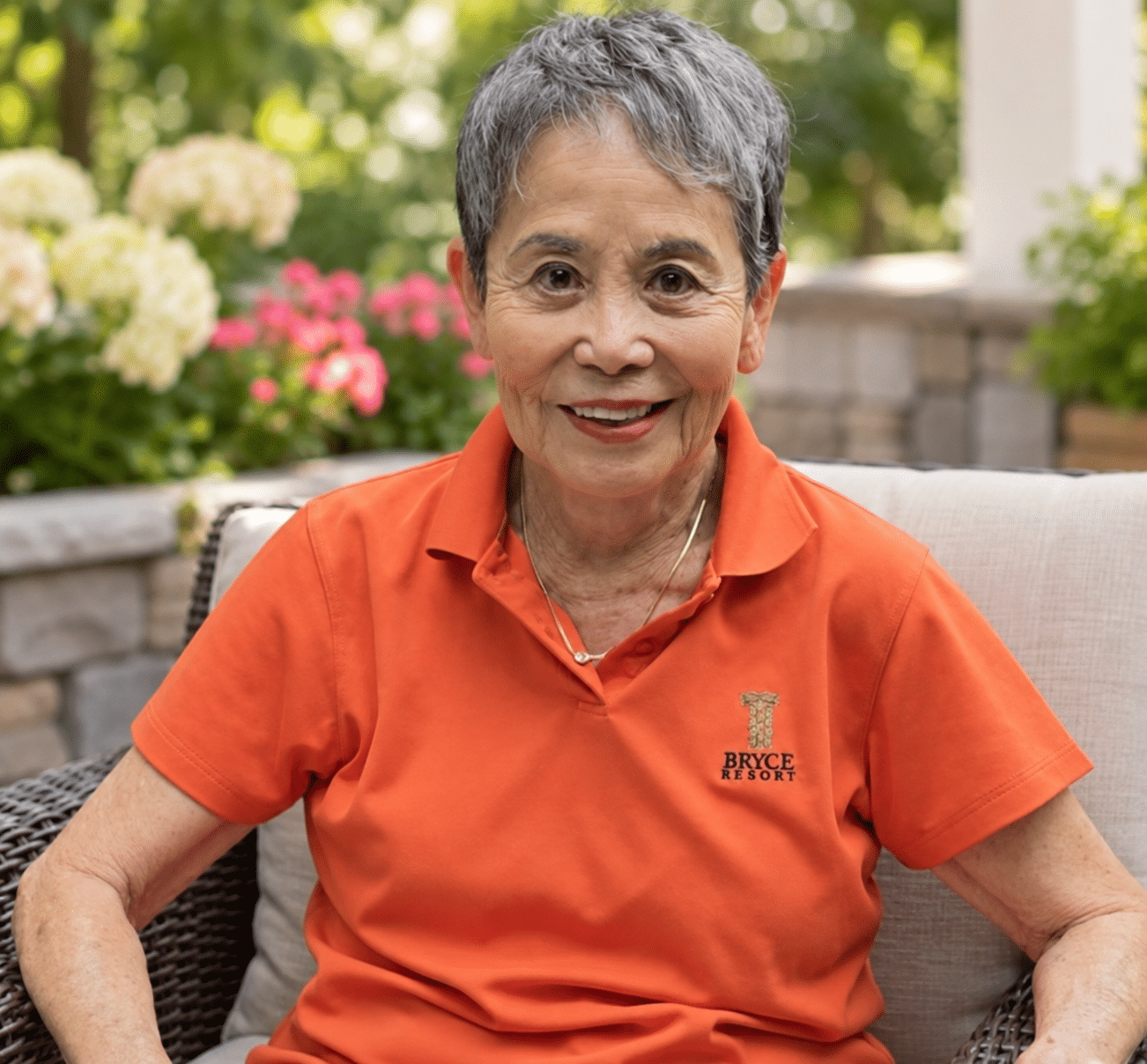
Every resident at Sunnyside arrives with a lifetime of stories, and some lives simply cannot be captured in a single post. There are stories that deserve more time, more space and the opportunity to unfold slowly. Today, we are excited to share Parts Two and Three of our four part series highlighting the remarkable life of Sunnyside resident Chris Carniglia. From her childhood in Japan during World War II to a career and life that would take her around the world, Chris’s journey is filled with extraordinary experiences, unexpected opportunities and moments in history she never could have imagined as a young girl. We invite you to continue following along as Chris’s remarkable story unfolds, one chapter at a time. Stay tuned for the fourth and final installment of this special series.
PART II
Joe entered Chris’s life so quietly that, at first, she hardly noticed the magnitude of what was happening.
By then, she had left boarding school after her father’s sudden death made tuition impossible. Japan was still rebuilding itself after the war, and like many young women with an uncommon skill, she found work with the American military. Years of English lessons that had once seemed frustrating suddenly became invaluable. While others struggled to communicate, Chris could move comfortably between two languages, and increasingly, between two cultures.
It was there, in an office filled with American servicemen, that a young Red Cross officer began asking about the quiet Japanese woman.
His name was Joe Carniglia. Chris had spent nearly all of her adolescence in an all girls boarding school. Men existed largely at a distance, encountered only at Mass or in carefully supervised settings. She had never really learned how to flirt. She had certainly never imagined dating an American.
Someone suggested she invite Joe for coffee.
It took courage just to ask.
“I finally got brave enough,” she says with a laugh.
Coffee became another coffee. Then another. Before long, they had fallen into the comfortable rhythm that so often precedes love, though neither of them could have known how complicated that love would become. What seems ordinary today was anything but ordinary in postwar Japan. The occupation had left complicated feelings toward American soldiers. Many Japanese families viewed relationships between local women and Americans with suspicion, often unfairly associating them with the difficult years immediately following the war. Chris understood exactly what people might assume if they saw her with an American man. Even her mother hesitated. When Joe invited Chris to see the cherry blossoms during Easter, her mother agreed on one condition. Chris’s older sister would come too.
So their first date unfolded beneath blooming cherry trees with an official chaperone quietly accompanying them. Today the story feels almost impossibly charming. Chris tells it matter of factly, as though every young couple begins that way.
Looking back, it seems almost poetic.
The war that had filled her childhood skies with fire was giving way to another spring beneath blossoms.
Their courtship was brief. Their separation would not be.
Not long after they met, Joe received orders transferring him to northern Japan. Telephone calls between the two were nearly impossible. Sometimes they relied on office operators willing to look the other way while business lines carried conversations that had nothing to do with work. Before long, Joe learned he would be returning to the United States.
Before he boarded the ship home, he placed an engagement ring on Chris’s finger.
Then he left.
For nearly six years, they remained engaged while an ocean stretched between them. Their relationship unfolded one letter at a time.
Today, in an era of instant messages and video calls, it is difficult to imagine building a future through envelopes that sometimes took weeks to arrive. Yet patience became another language they both learned to speak. They wrote about ordinary things because ordinary life was all they had to share. Seasons changed. Jobs changed. Countries changed. The letters kept coming.
Chris rarely told anyone she was engaged. In Japan, engagement rings were uncommon, and marriages were often arranged through families. Her own mother quietly tried introducing her to suitable young Japanese men, unaware that her daughter’s future had already been decided. Chris found creative ways around those meetings. Sometimes she simply sent a cousin in her place. She laughs at the memory now, delighted by the harmless deception.
Eventually Joe was assigned to the Philippines with the American Red Cross. Among his responsibilities was traveling regularly to Hong Kong, helping facilitate exchanges connected to prisoners and families divided by Communist China. His work carried him throughout Asia while Chris remained in Japan, waiting for the day distance would finally lose its hold over their lives.
That day arrived in December 1960.
After years measured by stamps and stationery, they were finally married. Only months later, another opportunity arrived. Joe was transferred to Hawaii to oversee Red Cross operations throughout the Pacific. Chris had never imagined living in America, and now she was crossing an ocean. If Japan had taught her resilience, America demanded adaptability.
She remembers one of her earliest encounters with American life not as intimidating but as wonderfully confusing.
Someone asked her to visit a drive through bank.
“Drive through??”
The phrase meant nothing to her. In Japan, banking required people. Counters. Buildings. Conversation.
When she arrived, she noticed a line of cars waiting patiently. Assuming the customers must stand behind their vehicles, she joined the line on foot. Every time a car moved forward, she stepped forward too. Patiently. Dutifully. Eventually she reached the pneumatic tube, accepted the paperwork, bowed politely to thank the unseen teller, and immediately found herself drenched by the automatic sprinkler system watering the landscaping. The banker laughed. Eventually, so did she.
The story has become one of her favorites, not because it embarrassed her, but because it reminds her how foreign America once felt. Every immigrant carries moments like these, small misunderstandings that eventually become treasured memories. Learning a country is about far more than learning its language.
Chris embraced the process with characteristic curiosity. She earned certification as a swimming instructor and began teaching children at Hickam Air Force Base. Soon afterward she volunteered with the Honolulu chapter of the American Red Cross, where her language skills again opened unexpected doors. Before long she was working with community organizations, helping connect people who otherwise might never have understood one another.
The pattern that would define the rest of her professional life had quietly begun. Chris never set out to become extraordinary. She simply kept saying yes.
Each opportunity led naturally to another. One volunteer assignment introduced her to someone else. One conversation opened another door. She had no grand career plan. Instead, she possessed something far more valuable. She was endlessly curious.
When she and Joe later moved to Washington, D.C., that curiosity found an even larger stage.
The nation’s capital in the 1960s and 1970s was a crossroads of diplomacy, politics, and international culture. Through the Red Cross, Chris found herself working alongside ambassadors’ wives, volunteers from embassies around the world, and representatives from organizations like the World Bank. She became a connector in every sense of the word, introducing people, translating conversations, building relationships that crossed not only language barriers but cultural ones as well. She often jokes that the women from the World Bank loved volunteering together because everyone spoke “limited English.”
“They understood each other perfectly,” Chris says.
It is one of those observations that reveals her gift for seeing humanity before difference. She never thought of herself as someone standing between Japan and America. She simply stood beside whoever needed help understanding someone else. That instinct, almost more than any particular accomplishment, would eventually carry her into places few people ever have the opportunity to see. The documentaries, the African safaris, the White House, the wildlife researchers, the film crews, the remarkable adventures that would define the next chapter of her life all began with something surprisingly ordinary.
A young woman who spoke two languages, and a willingness to answer the phone when opportunity called.
Part III
If Chris Carniglia’s life has a turning point, it is difficult to identify exactly where it occurs. Was it the day she accepted that first cup of coffee beneath the cherry blossoms? The day she boarded a plane for Hawaii? The day she learned that speaking two languages could become a profession instead of simply a skill?
Perhaps there wasn’t a turning point at all. Perhaps there was only momentum.
One opportunity quietly leading to another until, almost without realizing it, Chris found herself living a life she never could have imagined as a little girl watching wartime skies over Japan. By the time she settled into Washington, D.C., Chris had become something remarkably valuable. She wasn’t simply bilingual. She understood two cultures instinctively. She knew when translation required more than words. Sometimes what one person meant and what another person heard were entirely different things, and Chris possessed an uncommon ability to close that distance.
It wasn’t long before someone noticed.
Washington, surprisingly, had very few tour companies that catered to Japanese visitors. As Japan’s economy grew and international travel became more common, increasing numbers of Japanese tourists wanted to see America for themselves. Chris joined a company led largely by military spouses who worked as guides, eventually becoming one herself.
At first, she gave tours in English. Later, she realized Japanese visitors were not nearly as interested in memorizing dates or architectural styles as Americans often were.
“They wanted to know how Americans lived,” she says.
So instead of simply reciting facts about monuments and government buildings, Chris began interpreting America itself. She explained neighborhoods, traditions, schools, grocery stores, family life, and the little customs Americans hardly noticed because they had grown up with them. She translated more than language.
She translated everyday life. That reputation spread. Soon the phone began ringing.
Japanese television producers needed interpreters. Documentary crews needed coordinators. Reporters needed someone who understood both American institutions and Japanese expectations. Chris became the person people called when they needed someone who could navigate unfamiliar worlds without making anyone feel unfamiliar. The assignments grew steadily more remarkable.
One documentary explored America’s growing battle against illegal drugs during the Reagan administration. Chris found herself arranging interviews with the Drug Enforcement Administration, coordinating access to federal officials, and helping Japanese television crews navigate agencies that most Americans never see from the inside.
When producers wanted to interview officials at the White House, she simply picked up the telephone.
“I just called,” she says with a shrug.
The simplicity of the statement is almost comical. To Chris, it was merely another phone call. To everyone else, it sounds impossible. The assignments became larger.
She traveled to Miami to document international drug trafficking investigations, accompanying film crews as federal agents explained how smugglers carried narcotics across borders. She watched customs officers inspect flights arriving from South America. She stood beside cameras as investigations unfolded in real time, often finding herself in situations that felt more like scenes from a Hollywood thriller than public television.
None of it seemed to rattle her.
When she tells these stories today, the remarkable parts almost disappear beneath her modesty. She rarely describes what she accomplished. Instead, she remembers the kindness of officials who opened doors, the generosity of people willing to explain their work, or the humor that somehow found its way into even the most serious situations. Listening to her, one begins to realize that curiosity has always outweighed fear. That curiosity eventually led her somewhere altogether different.
Atlanta.
Researchers there were conducting groundbreaking work with bonobos and chimpanzees, exploring whether language could exist beyond the boundaries of humanity. Japanese television wanted to document the project, and once again they needed someone who could bridge worlds. Chris accepted.
For weeks she worked alongside scientists whose days revolved around remarkable animals capable of recognizing symbols, understanding spoken instructions, and communicating in ways few people believed possible. She watched young bonobos learn to build fires, respond to hundreds of words, and solve problems that challenged long held assumptions about intelligence itself.
The scientists fascinated her. The animals fascinated her even more.
She remembers one bonobo pressing the symbol for “quiet” after researchers had grown too loud during a meeting. She still laughs when she tells the story.
“It was amazing,” she says.
There is no need to embellish it. Wonder speaks well enough for itself. By then, producers trusted Chris completely. She had become far more than an interpreter. She coordinated logistics, secured permits, arranged transportation, negotiated with researchers, solved problems before anyone else recognized them, and somehow managed to remain calm while everyone around her hurried.
Those skills eventually carried her halfway around the world once again.
Botswana.
If her childhood memories are painted in shades of crimson from burning cities, her memories of Africa are filled with gold. Golden grass. Golden sunsets. Golden light stretching endlessly across the savanna.
She joined a Japanese film crew documenting African wildlife under the guidance of one of National Geographic’s most respected filmmakers. For forty days she lived among lions, elephants, wild dogs, and landscapes so vast they seemed to erase the horizon altogether. The accommodations were hardly luxurious. One evening she lay awake listening to lions roar just outside the small camp where she slept. Another morning she found herself surrounded by African wild dogs after stepping away from the group for a moment of privacy.
“I was surrounded,” she says, smiling now at what must have been terrifying then.
The crew spent dawns chasing packs of hunting dogs across the plains and evenings watching the sun disappear behind acacia trees. Chris remembers the rhythm of the work more than the danger. Wake before sunrise. Follow the animals. Wait patiently. Film only when nature decided something worth seeing would happen. It struck her that wildlife refused to perform on schedule. Sometimes entire days passed without a usable shot. Other days rewarded patience with moments no one could have planned.
That, she realized, was true of life as well. Looking back now, what feels most remarkable about Chris’s career is not where she traveled.
It is how naturally she belonged wherever she happened to be.
Whether speaking with diplomats in Washington, scientists in Atlanta, government officials in Miami, or filmmakers beneath African skies, she carried the same quiet confidence she first developed decades earlier as a shy boarding school student learning English one conversation at a time. She never chased adventure. Adventure simply kept finding her. And through it all, there was always Joe.
His own work with the American Red Cross frequently took him around the world, often sending him into disaster zones or humanitarian crises while Chris pursued projects of her own. Their marriage was built on unusual independence and extraordinary trust. Neither demanded explanations for every journey. Neither stood in the way of the other’s calling.
“If you want to go,” Joe would tell her, “go.”
So she did.
Together, they built a marriage that stretched across continents as comfortably as it once stretched across oceans. By the time Chris’s professional life began slowing, she had accumulated enough experiences to fill several lifetimes.
She had stood beneath skies darkened by war. She had welcomed peace with a pocket full of chocolate. She had crossed the Pacific for love. She had introduced Japan to America and America to Japan. She had spent decades helping strangers understand one another.
Remarkably, she still insists she was simply fortunate. Perhaps she was.
But, fortune alone does not explain a life like Chris Carniglia’s.
Fortune may open a door.
It still takes someone willing to walk through it.
For nearly a century, that is exactly what Chris has done. With the quiet confidence of someone who never imagined her life was extraordinary, even as history quietly unfolded around her.