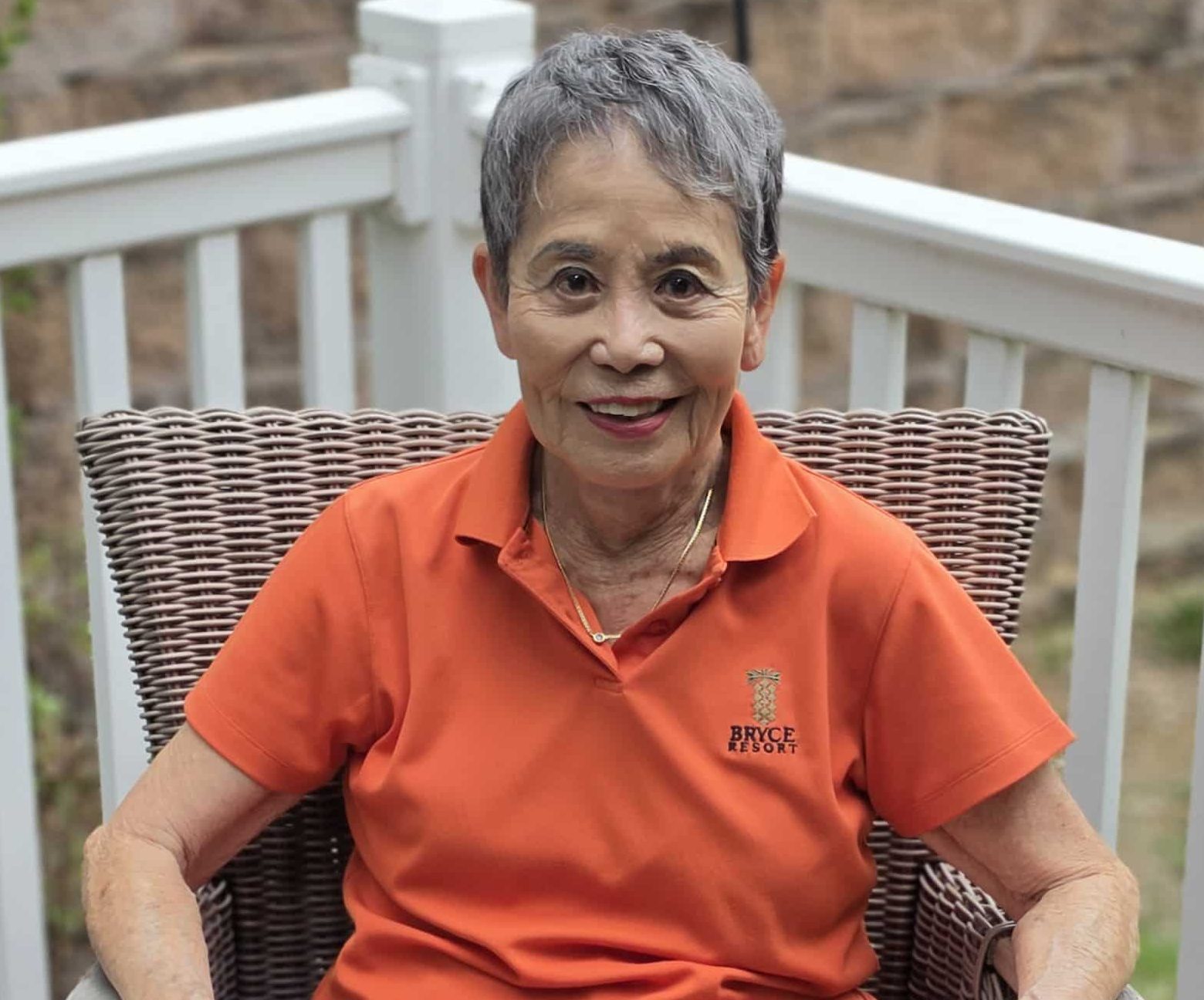
Every resident at Sunnyside arrives with a lifetime of stories, and some lives simply cannot be captured in a single post. There are stories that deserve more time, more space and the opportunity to unfold slowly. For the first time, we are doing just that.Over the next several weeks, we will be sharing the remarkable story of Sunnyside resident Chris Carniglia in a series, following her life from a childhood in Japan during World War II to a career and life that would take her around the world and place her in moments of history she never could have imagined as a young girl. We hope you will follow along each week as we share Chris’s story, one chapter at a time.
The first thing Chris Carniglia apologizes for is her dog.
Kura, seventeen years old and nearly blind, pads quietly across the hardwood floor before settling into a familiar patch of afternoon sunlight. Chris watches her with the sort of attentive affection that only comes after years of shared routines. “Today she doesn’t want to eat,” she says, almost to herself. After a thoughtful pause, she adds, “She’s seventeen.” It is not a lament, simply an observation. That, it turns out, is how Chris tells nearly every story.
The home she welcomes visitors into feels much like its owner. It is elegant without asking for admiration. Japanese artwork hangs carefully against pale walls, while shelves display porcelain, photographs, and keepsakes collected over the course of nearly a century, though none seem arranged for effect. They belong where they are because they have earned their place. Nothing in the room announces itself. Instead, everything invites a slower look.
“I bring my culture,” she says simply.
The words explain more than the décor. Chris has spent ninety one years carrying one world into another. She was born in Japan in 1935, long before anyone could have imagined the shape her life would eventually take. She would become an interpreter and coordinator, a liaison between governments and television crews, a world traveler, a mother, a wife, and, almost accidentally, a witness to some of the twentieth century’s defining moments. She would help filmmakers negotiate access to the White House, spend weeks living among wildlife in Botswana, work alongside scientists studying language in chimpanzees, and build a life in America without ever leaving Japan behind. Yet listening to her speak, one quickly notices something unusual. She tells none of it as though it were extraordinary. History arrives in her stories with the same measured cadence as a neighbor dropping by for coffee.
Ask about her childhood, and she does not begin with war. She begins with home. Her family lived in the Japanese countryside, where life followed the rhythms of the seasons more closely than the headlines. The hills were familiar and rivers became playgrounds. She remembers running wild with neighborhood children, climbing where she pleased and returning home with the sort of muddy confidence that worried her parents more than it worried her. “I was a very wild country kid,” she says, laughing. It is easy to picture her that way, curious and restless, more interested in exploring than behaving.
Chris’s childhood, however, unfolded during World War II, and eventually the war reached even the quiet countryside she called home. By the time she was ten years old, American bombing raids had become part of life in Japan, and some nights the sky seemed to catch on fire.
The family lived far enough from the cities to escape the worst of the bombing, yet close enough to watch the destruction unfold from a distance. Air raid sirens became part of ordinary life. Whenever they sounded, her older sisters would hurry to wake the youngest member of the family, helping her stumble out of bed before leading everyone toward safety. She remembers struggling to wake up, adults rushing around her and the fear of knowing that somewhere nearby bombs were falling. Most of all, she remembers the color.
“The whole sky was red,” she says quietly. “I was shaking.”
Children experience war differently than adults. Adults may remember political decisions, military campaigns, victories and defeats, while children remember sounds and smells and where they stood when everything changed. Chris remembers watching a nearby city disappear beneath waves of incendiary bombs that floated through the darkness like fireworks before setting entire neighborhoods ablaze. She remembers standing on a hillside, too young to understand strategy or ideology, but old enough to recognize that something terrible was unfolding beyond the horizon. More than eighty years later, it remains one of the clearest memories of her childhood.
When Japan surrendered, the family gathered around a radio to hear Emperor Hirohito address the nation. The adults cried while Chris watched them without fully understanding why. The emperor spoke in formal court language, a style so traditional that even many Japanese adults struggled to understand every word. For a ten year old girl, the speech was almost impossible to follow. She could not grasp its political significance, only the emotion filling the room and the sense that something irreversible had happened. The war that had shaped every corner of her young life had finally come to an end.
Soon after Japan’s surrender, American occupation forces arrived, and Chris’s memory of their arrival is tied to something surprisingly small: chocolate.
One of the American soldiers gave her what she remembers as M&M’s. Her older sisters had known American sweets before the war, but Chris was too young to remember them. By the time she was old enough, years of wartime shortages meant treats like chocolate had all but disappeared from her childhood. To ten year old Chris, the colorful candies were something entirely new.
She carefully tucked them into the tiny pocket sewn onto the front of her dress, but a few slipped from her hands and fell to the ground. Chris immediately bent down to retrieve them. Her mother told her not to, but after years in which something as simple as candy had been nearly impossible to come by, leaving them there was difficult for a child to imagine.
“I still remember wondering if I should,” Chris says with a sheepish smile. “I picked them up.”
More than eighty years later, the memory still makes her smile. It is a small story set against an enormous moment in history, but perhaps that is precisely why she remembers it. Chris was only ten years old. She did not experience the end of World War II through politics or diplomacy. She experienced it as a little girl standing near an American soldier, holding chocolate she had never tasted before and trying not to lose a single piece.
Not long after peace returned, Chris’s father made a decision that would quietly alter the course of her life. He worried about his youngest daughter, not because she was troubled, but because she seemed impossible to contain. She preferred rivers to classrooms, climbed hills with farm children, and possessed an independence that seemed likely to grow stronger rather than weaker with age. Her older sisters were already attending a private girls’ school near town, and eventually he decided that twelve year old Chris should join them.
The transition was abrupt. One day she was a country girl chasing adventures outdoors; the next she was navigating the structured environment of a private girls’ school near town, where she encountered an immediate and considerable problem: she did not speak English.
“I didn’t know any English,” she recalls, before reconsidering. “I knew A, B, C.”
On the second day of school, the class was assigned English spelling homework. Chris arrived the following day without it, not because she had refused to do the assignment, as her teacher initially believed, but because she had no idea homework had been assigned in the first place. Fortunately, the principal understood the situation better. Rather than punish her, he instructed the faculty to give the quiet Japanese girl time to learn at her own pace.
For years, Chris listened more than she spoke, and it was an education that would shape far more than her language. School taught discipline, patience and observation. Most of the instructions came in English, forcing her to rely on classmates, context and careful attention to understand the world unfolding around her. Without realizing it, Chris was developing the very skills that would later carry her across continents. Language would become her passport long before she ever owned one.
Somewhere beyond the walls of that school, however, another part of Chris’s story was waiting to begin. His name was Joe.