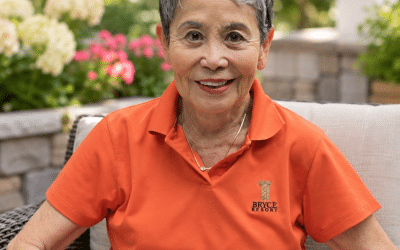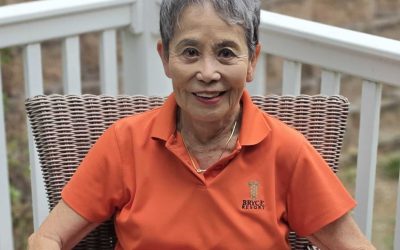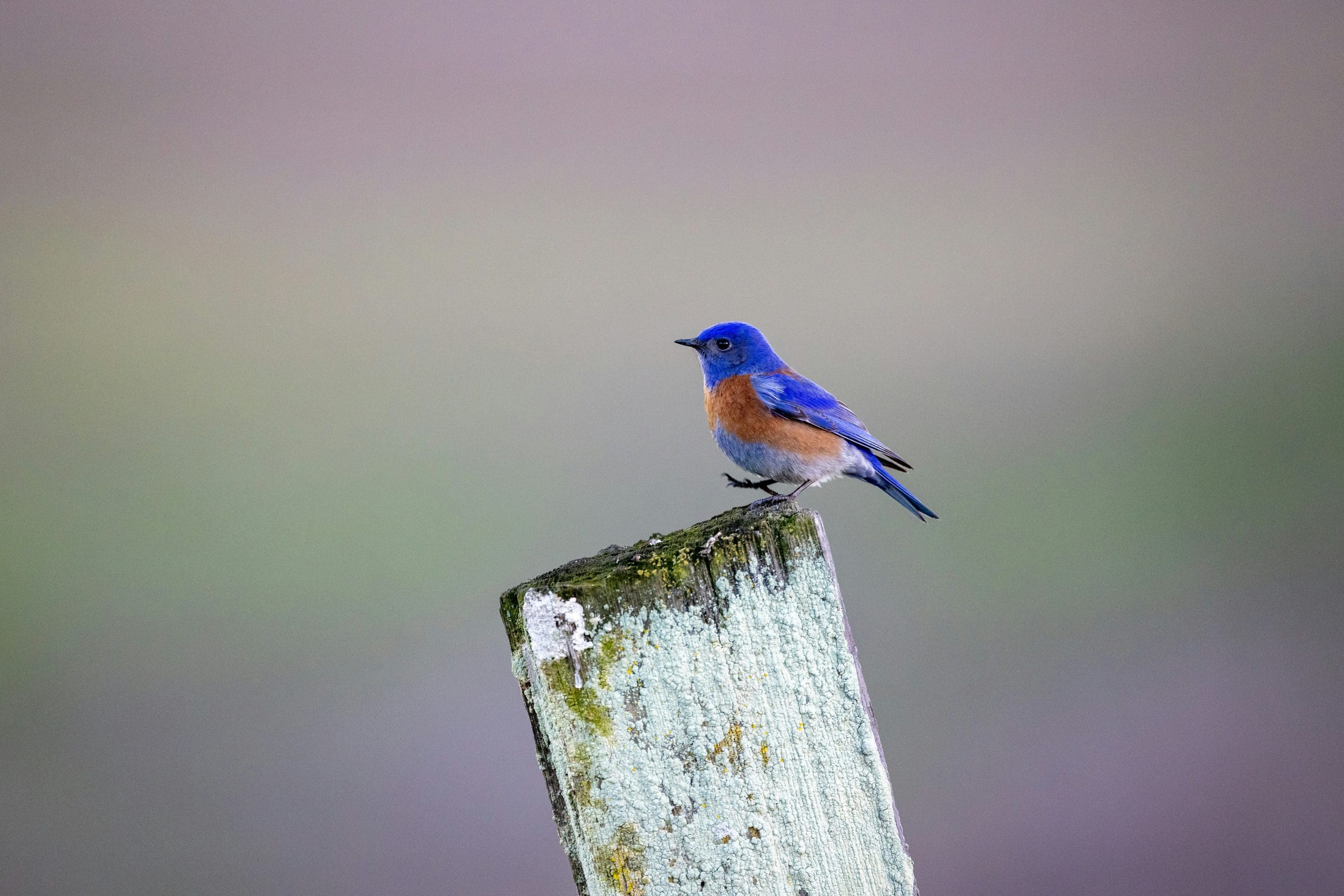
Walk into Gail Fisher’s cottage at Sunnyside and bluebirds are everywhere.
Bluebirds on the wall. Bluebirds on the shelves. Bluebirds perched on the welcome sign beside the door. It feels less like decorating and more like a thesis statement.
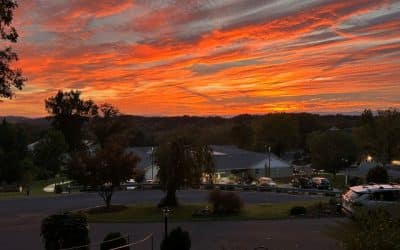
Gail greets visitors with a grin. Light pours into the living space she and her husband Jim created after moving to campus in June 2021. What was once a deck is now glass and sky, the Shenandoah Valley rolling out in front of them.
They traded decades in Cape May County, New Jersey for this view. They used to camp in the region for fun. Now they are here for good.
Gail’s bird story did not begin at Sunnyside. Long before retirement she was a purple martin landlord in New Jersey, mentored by the founder of the New Jersey Bluebird Society. That mentorship grew into banding nestlings, managing trails, and eventually coordinating efforts countywide. She learned how to place boxes, how to monitor responsibly, and how to think like both prey and predator.
One year, just before she left New Jersey, a bluebird she banded was found in Nova Scotia after a storm forced it north. Someone read the tag, reported it to the federal bird banding lab in Maryland, and the data circled back to her. A small metal ring had mapped a life across state lines and into Atlantic wind.
When Gail arrived at Sunnyside, she found bird boxes already scattered across campus, remnants of earlier resident led efforts to support bluebirds. Some were built from leftover wood used to create tree identification signs. Residents had mounted them on trees and posts. They had heart. They did not always have predator guards.
In recent years, an “Adopt a Birdhouse” program led by residents helped keep many of those nest boxes active and built additional ones, laying the groundwork for a healthy bluebird population. Gail was able to build on that foundation.
She went to the Green Committee. She connected with Cindy Westley, Master Naturalist and resident force of nature. Together they took inventory, removed boxes that were beyond repair, and asked the campus woodworkers, affectionately known as the Termites, to salvage what they could. Gail sourced proper poles and predator guards. With no formal funding stream at first, she opened a small account. Donations quietly appeared.
Now there are five active trails and roughly 45 boxes across the property. Many are scattered along the golf course land Sunnyside owns, wide stretches of mowed grass that bluebirds love. That landscape is prime real estate. Open ground for hunting insects. Clear sight lines. A nearby perch for the male to guard while the female incubates. A shrub within fifty yards so fledglings have somewhere to disappear when they make their first terrifying leap.
Bluebirds are methodical. The female builds her nest from pine straw or grass. She lays one egg each morning, usually five in a clutch. Incubation does not begin until the final egg is laid, ensuring the hatchlings emerge together. Fourteen days later, the eggs crack open. Both parents feed the nestlings for about sixteen days. When the young leave the nest, it is called fledging. They do not return to the box. The adults continue feeding them for roughly two more weeks while they learn to navigate a world full of risk. If the season allows, the female may begin again. Two broods before summer closes.
During nesting season, five resident volunteers monitor the trails weekly. They log dates. They calculate hatch windows. They estimate fledging days. Each box is opened carefully from its side door, knowing that proper management requires vigilance.
Several of the boxes have cameras installed inside. A handful stream footage to nearby homes. One is hard wired directly into assisted living, broadcasting a live feed into the puzzle room so residents can watch blue eggs turn into living, blinking creatures. It is reality television without producers.
A safe nest box is not decorative. It must be mounted on a metal pole with a predator guard. It needs thick wooden walls, a wide roof, ventilation near the top, no perch to give predators leverage, drainage holes in the floor corners, and small interior grooves so fledglings can climb out. Details matter. A poorly designed box can cost a brood its life.
Gail often climbs into her golf cart and makes a full loop of the property, taking inventory. She checks placements. She studies habitat. She points out paired boxes installed to reduce territorial conflict between bluebirds and tree swallows. Density must be managed carefully. Too many boxes invite competition and predators. Too few limit opportunities.
She does not sugarcoat the darker side. Invasive house sparrows can take over a box, crush eggs, kill nestlings, even attack the adult male defending his family. Monitoring sometimes means opening a nest box door without knowing what waits inside. Conservation is not sentimental. It is hands on and sometimes hard.
Still, there is wonder threaded through all of it.
There was a male bluebird across the street who learned the sound of her front door. At a soft kissing noise, he would appear instantly for live mealworms during cold, wet spells when insects were scarce. He returned for three years. In bluebird terms, that is an epic run.
What Gail has built at Sunnyside is not just a trail system. It is an ecosystem supported by volunteers, funded through community partnership, and woven into daily life. Residents walk the golf course and glance at poles not as scenery but as active homes. Assisted living residents gather around a screen to watch hatchlings stretch their necks toward the light.
Those interested in learning more about bluebird conservation and responsible monitoring can explore additional resources through the Virginia Bluebird Society at www.virginiabluebirds.org/.
Spring is about to break open. The males will begin singing from the rooftops of their boxes. The females will inspect, decide, commit. Across campus, wooden doors will be opened carefully, notebooks in hand.
Retirement did not quiet Gail Fisher. It gave her acreage.