Few words change a family conversation faster than the word dementia. A diagnosis often arrives wrapped in fear, urgency, and uncertainty. Adult children begin researching late into the night. Spouses quietly wonder what life will look like a year from now. Families start asking difficult questions long before they feel emotionally ready for the answers.
Almost immediately, many people assume the same thing:
“If Mom has dementia, does that mean she needs memory care right now?”
Not necessarily.
At King’s Grant, one of the most important conversations staff members have with families is helping them understand the difference between assisted living and memory care and why a dementia diagnosis alone does not automatically determine where someone belongs.
Because dementia is not one single experience. It exists on a spectrum. Some individuals in the earlier stages of dementia remain highly social, independent in many ways, and fully capable of participating in everyday routines with only minimal support. Others may require more structured environments, increased supervision, or specialized cognitive care.
The question is often less about the diagnosis itself and more about how the symptoms are affecting daily life.
What Is Assisted Living?
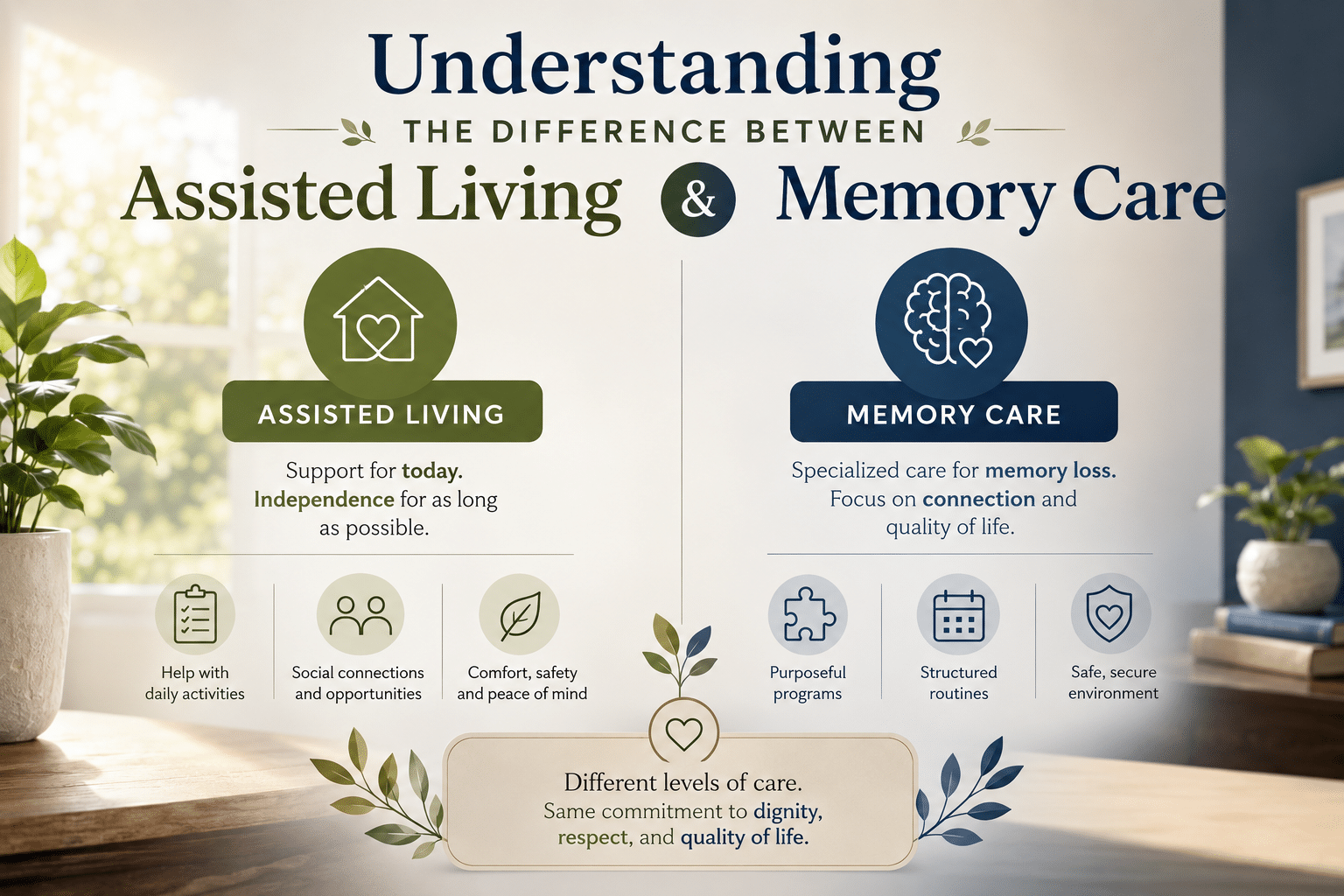
Assisted living is designed for older adults who may need support with certain activities of daily living while still maintaining a meaningful level of independence.
At King’s Grant, assisted living residents may receive help with things like:
• Medication management
• Bathing or dressing assistance
• Meals and nutrition
• Housekeeping and laundry
• Mobility support
• Transportation and wellness services
Many assisted living residents are active, social, and engaged in community life. They attend activities, dine with neighbors, participate in wellness programming, and continue enjoying routines that feel familiar and comforting.
Importantly, some residents in assisted living may also have an early dementia diagnosis.
A person can experience mild memory loss or cognitive changes while still functioning well within an assisted living setting.
What Makes Memory Care Different?
Memory care is a more specialized level of support specifically designed for individuals living with more advanced cognitive impairment, including Alzheimer’s disease and other forms of dementia.
Memory care environments are intentionally structured to provide:
• Increased supervision and safety
• Specialized dementia trained staff
• Secure environments to reduce wandering risks
• Cognitive focused programming
• Routines designed to reduce anxiety and confusion
• Additional support with behavioral and emotional changes
Residents in memory care often require more cueing, redirection, or hands on assistance throughout the day. In many cases, memory care becomes appropriate when cognitive changes begin significantly impacting safety, judgment, emotional regulation, or daily functioning.
The Timing Matters More Than the Label
One of the biggest misconceptions families have is believing a diagnosis itself dictates placement. In reality, two people with the exact same diagnosis may have completely different care needs.
One person may thrive in assisted living for years with mild support and social engagement. Another may require memory care sooner due to wandering, significant confusion, nighttime behaviors, or safety concerns.
This is why care assessments matter so much. At King’s Grant, teams work closely with families to evaluate not just the diagnosis, but the whole person. How are they functioning day to day? Are they socially engaged? Are they safe? Are they isolated at home? Are medications being managed correctly? Are caregivers becoming overwhelmed?
Those answers often tell a much fuller story than a medical label alone.
Why Families Sometimes Wait Too Long for Either Level of Care
Ironically, families often fear “moving too soon,” while simultaneously waiting until exhaustion or crisis forces a decision. Spouses become caregivers around the clock. Adult children try to manage increasing needs remotely. Small concerns slowly grow into dangerous situations. Yet many residents, once settled into the right environment, experience something families did not expect:
Relief. Relief from isolation. Relief from managing everything alone. Relief from the fear of what happens if something goes wrong in the middle of the night.
Whether someone is best suited for assisted living or memory care, the goal is ultimately the same: dignity, safety, support, and quality of life.
The Diagnosis Is Not the Whole Story
A dementia diagnosis can feel overwhelming because families often imagine only the most advanced stages of the disease.
But, dementia journeys look different for everyone.
Some individuals continue living actively and meaningfully for years with the right support systems in place. Others benefit from earlier transition into specialized memory care environments designed specifically around cognitive wellness and safety.
At King’s Grant, families are encouraged not to panic, not to assume, and not to navigate these decisions alone.
Because sometimes the most important thing a family can hear after a diagnosis is this: You still have options.