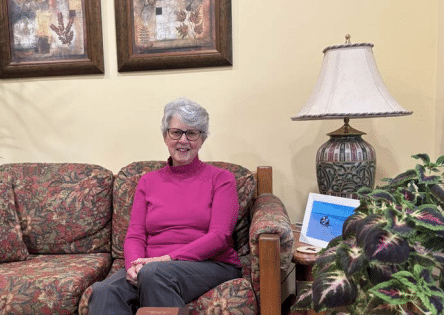
On a recent afternoon at King’s Grant, in an apartment painted a particular shade of yellow that once belonged to a house in Henry, Virginia, Anne Hartman sat near a window and began, as she has likely begun many conversations in her life, at the beginning.
“Originally, Charlotte, North Carolina,” she said.
Anne has the calm composure of someone who has made peace with a long string of relocations. She grew up in Charlotte and met her husband, John, at Wingate College, just outside the city. He was from Roanoke. She speaks of their meeting as providential, not accidental.
“We felt like God did that,” she said, the way some people say we met at a party.
They married in 1964. From there, their life became a series of addresses.
Roanoke. West Virginia. Virginia Beach. Back to Roanoke. St. Louis. Cleveland. Back to St. Louis. Back to Cleveland again. Finally, retirement brought them to Smith Mountain Lake.
The list sounds exhausting when recited aloud. Anne does not present it that way.
“It wasn’t really easy,” she said. “But, I knew what I needed to do.”
Her husband worked for the railroad. Transfers came with little warning and less negotiation. Each move meant new schools for their two daughters, new churches, new neighbors, and new jobs. Before each relocation, Anne would cry. Then, almost without fail, she would find herself loving the place she had dreaded.
When John told her that they were moving to Cleveland, she cried “my eyes out.” She did not know much about the city and imagined gray skies and distance from everything familiar. Instead, she discovered Lake Erie, sailing, and a banking career that would eventually make her a senior vice president.
“It was hard to leave,” she said, as if still slightly surprised by that fact.
Anne’s first degree was in math and French. She loved both, but she did not want to teach. In St. Louis, a principal once told her that if she would just finish her teaching degree, he would hire her immediately. She tried. One semester back in education courses convinced her it was not the path.
A professor suggested business.
At the time, it was not an obvious choice for a woman with two children who moved every few years.
“This was something women didn’t do a lot of at that time,” she said.
She earned a degree in business administration from the University of Missouri St. Louis and took a job at McDonnell Douglas, working with engineers on the F 15 fighter jet. It was a position the company had never hired a woman to fill. She loved airplanes. An uncle had helped start Piedmont Airlines, and the hum of aviation felt familiar.
The barriers were not abstract. When she later interviewed at a Ford plant in Cleveland, the hiring manager told her they did not even have women’s restrooms.
“They didn’t hire women,” she said, not with outrage but with clarity.
So, she pivoted to banking. Health care, teaching, banking, those were the professions she decided could move with John’s railroad career. She joined a bank in Cleveland and entered its management training program as the first woman to do so.
She remembers giving a cost saving presentation to a room of eight bank presidents.
“Men,” she added, with a small pause.
She eventually rose to senior vice president, a title she mentions without flourish, as if it were simply the logical conclusion of showing up and doing the work.
Through all the relocations, her daughters adapted with a resilience that still amazes her.
“They were good sports,” she said.
She remembers being struck by their lack of tears when leaving friends behind. Anne did not work outside the home until they were nearly in middle school. In those early years, she was a Girl Scout leader and a steady presence. Later, she balanced corporate responsibility with motherhood and church life.
Church was a constant throughout.
Every time they moved, the pattern was the same. John would find a house. Anne would evaluate it. They would move in. Then they would look for a church. They worked with children and youth groups in nearly every congregation. John served as chairman of the deacons more than once.
“We just wanted to serve God,” she said.
Sixteen years ago, that partnership changed.
After retiring to Smith Mountain Lake, drawn by their love of boating, Anne and John moved closer to their younger daughter and son in law in Henry, Virginia. They bought an acre from them and began building a house. During construction, John was diagnosed with Lewy body dementia.
Anne’s sister’s husband had died from the same illness a decade earlier. They had never heard of it until then.
The signs were subtle at first. A crash in the garage after forgetting to open the door. A moment on the boat when John, once capable of sailing in a storm, seemed disoriented. A friend quietly urging Anne to get him to a doctor. Eventually, a physician familiar with the disease confirmed it.
He lived three years after the diagnosis. For most of that time, Anne cared for him at home. She was teaching Bible study, managing the household, and watching the man who had navigated rail schedules and church committees slowly lose his bearings. The final three months were spent in a memory care unit in Salem, a long drive from Henry but a place where, she said, “they were so good.”
Caregiving took a toll. She does not dramatize it, but she acknowledges the weight. In her journal, she wrote to God, sometimes unsure whether to keep going. Those journal entries, shared in emails with a cousin who asked regularly how she was doing, eventually became a book.
A cousin read the emails and told her, “You have got to write this in a book.”
The book is titled Though He Slay Me, taken from the Book of Job. It is a phrase that captures both defiance and surrender. John, she said, remained devoted to his faith even as his mind failed him.
Years later, a woman who had been in their youth group in St. Louis wrote to Anne’s daughter on Facebook. She described the impact Anne and John had on her life. She was now married to a pastor.
“You don’t know who you’re helping,” Anne said. “You just don’t know.”
Nearly two years ago, Anne faced another decision.
Her son in law suggested she begin looking at senior living communities while she was in good health. She visited friends in South Carolina, who had recently moved into a similar community. When she asked them for the pros and cons, they answered almost in unison, “There are no cons.”
She toured several places. One had too many views of parking lots.
“I want scenery,” she said.
King’s Grant offered trees, familiarity, and friends she already knew from church. She chose an apartment, not a cottage.
“If I was going to do that, I would have stayed in my house,” she said.
She prayed for two years before deciding.
Now she leads Bible study here, as she has done since she was 20 years old. She serves on the Resident Council. She participates in GriefShare, a grief recovery support group, at church and speaks to those who have lost spouses. When asked what she would want people to understand about grief, she answered without hesitation:
“Depend on Jesus and God to help you get through it.”
On a side table in her apartment are printed Bible verses she hands to people. Ephesians 2:10. Philippians 1:6. She recites them as if they are coordinates.
The yellow walls are the same Sherwin Williams shades she chose when she built her house in 2006. The paint numbers have not changed. The plants by the window will go back outside in warmer weather. Her daughter and son in law visit every Wednesday before church.
“I told Him,” she said, referring to God, “I’ll serve you anywhere.”
In a life marked by departures, Charlotte, Roanoke, Cleveland, St. Louis, the lake, the house in Henry, the husband she lost, Anne Hartman’s story is less about where she lived than about how she responded. Each move, each promotion, each illness, each grief has been met the same way: with a quiet, persistent yes.
Now, in the apartment painted to match a house that no longer belongs to her, that “yes” continues.