Linda’s view
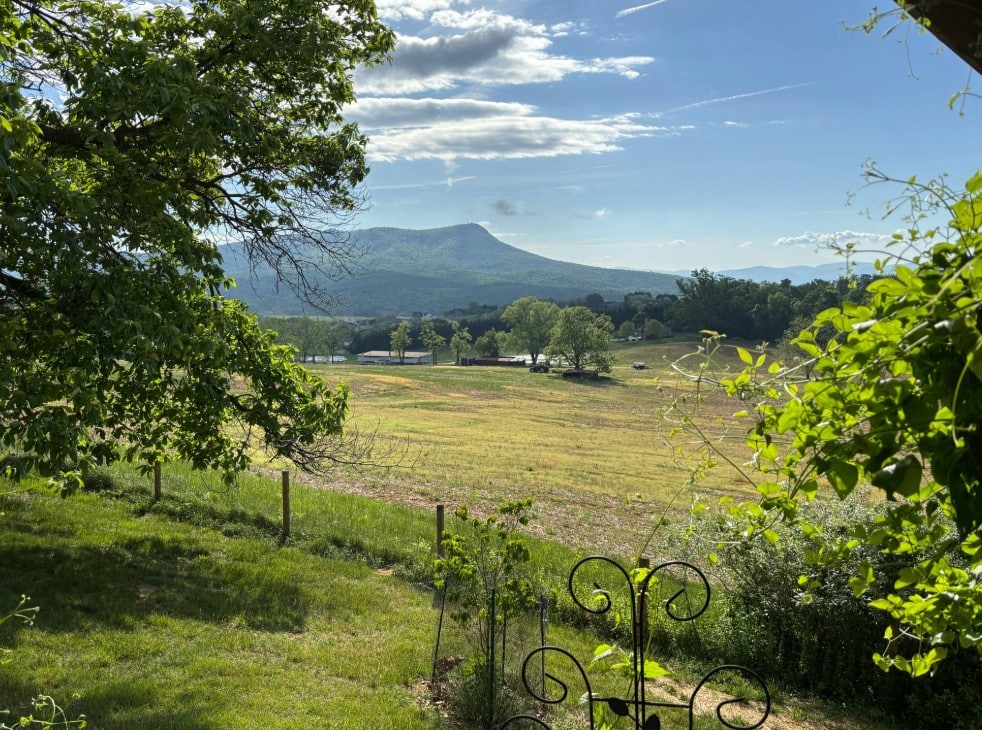
By the time Linda Combs walks you through her cottage at Sunnyside, she’s already pointing toward the view. Out back, just past the trees, you can see a pumpkin patch in the fall and beyond that the most gorgeous view of Massanutten Mountain. It’s one of the reasons she and her husband chose this house. The location felt close—to nature, to town, and to everything that had mattered.
Her parents lived here too. Not in this house, but across campus—first in an apartment at the Highlands, then in Assisted Living (AL), Memory Care, and eventually, the Health Center. They moved through nearly every level of care Sunnyside offers. And Linda was with them through all of it.
“I got to know them as people,” she says. “Not just as my parents.”
Linda became the point person for everything. The one coordinating care, fielding phone calls, navigating appointments. She wrote to the DMV when her father’s driving became unsafe. She handled hospital discharges, medication changes, and more than a few meals from McDonald’s for her fast-food-loving father. She was the first to show up and the last to leave.
Her story reflects the reality for many adult children who find themselves caregiving from the middle of their lives. But what makes Linda’s story remarkable isn’t just the length of time—it’s the clarity with which she remembers it, and the gratitude she still carries.
Linda and her husband moved to Harrisonburg in 1991 from Charlotte, North Carolina. She’s originally from Bedford, and once they got to the Shenandoah Valley, she knew they were staying. They built a house near Spotswood Country Club and remained there for more than three decades.
Her parents stayed in Bedford for a while, then moved to a retirement community in Roanoke. It worked—until it didn’t. Their health declined. Linda, still working full-time at James Madison University, was making frequent trips back and forth. She assumed they’d want to stay in Roanoke. But when her sister asked if she’d ever considered Sunnyside, it changed everything. Linda scheduled a tour.
“I told the marketing director they were in their 80s and still independent, but they were having health issues,” she says. “She looked at me and said, ‘They’re not ready for AL. Let me show you something else.’”
The Highlands apartment they toured only had one bathroom, which her mother didn’t love. But otherwise, it was the right fit. Her father thrived in the social atmosphere of the dining room. Her mother settled in. And Linda—just two miles away—became familiar with every corner of campus.
Later, when her father’s driving became risky, a Sunnyside staff member encouraged her to write the DMV. The letter led to a required retest. He declined, and the car stayed parked. “It took the pressure off me,” Linda says. “And he never knew it was me who reported him.”
Over time, his health issues intensified—heart failure, lymphedema, mobility loss. After a hospital stay, the care team told Linda he couldn’t return to his independent apartment. He needed long-term care.
She broke the news. He accepted it.
“He already knew everyone in healthcare,” she says. “He was still himself. Friendly. Talkative.”
Then came kidney failure. Dialysis was offered. He declined. What followed, Linda says, was extraordinary. Sunnyside’s staff scheduled a meeting. Her father, a retired businessman, sat at the head of the table. The head nurse, chaplain, social worker, and provider all took part.
“He said he didn’t want to keep taking medication. He knew what that meant,” Linda recalls. “And they let him make that decision.”
Hospice arrived the same day. He passed ten days later.
Linda stayed by his side the whole time. So did the staff. Nurses made her tea. The chaplain visited. Hospice made sure he was comfortable.
“There’s no amount of money that could’ve bought better care,” she says.
After his death, her mother remained at the Highlands. She was surrounded by friends at mealtime, but her days were quiet. She began experiencing auditory hallucinations. Then came the call that she’d been rushed to the hospital. There was fluid on her brain. She was discharged late that night, and Sunnyside’s nurse was waiting when Linda brought her back.
That began a new cycle: rehab, AL, growing memory issues. Eventually, she was diagnosed with vascular dementia. When she started wandering at night—once trying to visit the salon at 2 a.m.—the team recommended memory care.
Linda softened the move by telling her mother that AL was being renovated. She adjusted slowly. Friends and familiar faces helped. But eventually, memory care wasn’t enough either. After a string of falls and increased confusion, she was moved again—this time to the Health Center.
At first, she resisted. Then a nurse approached her and asked, “Was your husband Bill?”
“I took care of him,” the nurse said. Eight years had passed. She still remembered.
Her mother’s decline was slow. She stopped eating. She begged Linda not to leave, even after hours of sitting together.
“It felt like taking a child to kindergarten again,” she says. “But she was 98.”
Hospice came again in January 2025. Her mother passed on February 1.
Today, Linda and her husband live in a home at Sunnyside, just across campus from the rooms where her parents spent their last years. She plays mahjong. Volunteers. Shares stories about the residents she met through her parents—like the French woman raised in Vietnam, or the man who survived Pearl Harbor.
She doesn’t romanticize what caregiving was. It was hard. It was daily. But she does see it clearly: the full arc of care, from independence to goodbye, and all the moments in between.
“Sunnyside was the right place,” she says. “For them. For us. We found peace here.”