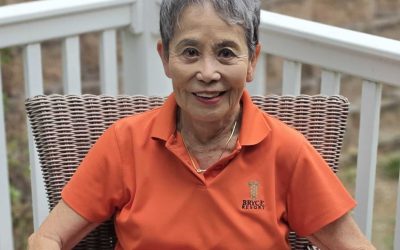
By the time Judy Mone moved into Sunnyside, the view had already won her over.
She didn’t need much. Just a little space of her own, a window facing the walking trails, and the chair her husband had always sat in. She’d carried it with her after he died. It sits now near the window, angled just right to catch the morning light from the balcony just off her apartment. Birds sweep past. The wind shakes the trees. From that chair, she can see people walking dogs, heading to classes, moving through the same kind of days she’s learning to make her own.
At 84, she’s not reinventing herself. Not exactly. But she is learning something new: how to be alone without being lonely. How to be still without feeling stuck. And how, in this next chapter, she might grow.
Judy didn’t come to Sunnyside by herself. Her daughter, Sheryl Powers, came too—though for different reasons.
Before she ever worked there, Sheryl drove by the community nearly every day. As a real estate agent in the Shenandoah Valley, she passed the entrance on the way to showings and open houses, always noting how green and wide the campus looked. “What a beautiful place,” she used to think, before continuing on her way.
Then came the pandemic.
Sheryl’s parents—Judy and her husband—moved in with her just as COVID shut down the world. It wasn’t easy. Her father’s Alzheimer’s had progressed. There were hard days and long nights. But there was also an unexpected comfort in that closeness. “It was so nice to be quarantined together,” Sheryl said.
When her father died, Judy stayed. She wasn’t ready to live alone. But it quickly became clear their home—quiet and rural, tucked just outside town—wasn’t what Judy needed most.
“She’s always been social,” Sheryl said. “She needed more than we could give her out in the country.”
At first, they tried another retirement community, closer to Charlottesville. It seemed like the right move. But almost immediately, it became clear that it wasn’t the right fit.
“She lasted six weeks,” Sheryl said. “She called and said, ‘Get me out of here.’”
When they returned to the Valley and began looking at Sunnyside, Sheryl took the lead. This time, she chose everything: the apartment layout, the cabinetry, the paint colors, even the light fixtures.
“I picked the colors to match her old bedroom,” Sheryl said. “I wanted it to feel familiar—like a continuation, not a restart.”
When Judy walked in for the first time, she looked around the space—soft light, warm walls, a chair by the window—and simply nodded.
This was it.
It was spring—just after the worst of the pandemic had passed, when everything still felt breakable and uncertain. Sheryl had taken a leave from work. Judy was grieving. They toured the community, this one different from the last. The buildings felt more familiar. The pace more natural.
That night over dinner, Sheryl turned to her mother and said, “I hope you move there—because I’m going to apply for a job.”
They both followed through.
That summer, Sheryl joined the staff at Sunnyside. By fall, Judy had moved into her own apartment on campus, just a few floors above Sheryl’s office.
For Judy, the change was subtle at first. Her new place was smaller than the home she’d shared with her husband, but it was hers.
“I sit here a lot,” she said, looking out the window. “I’ve never had just me before.”
She wasn’t exaggerating. Judy married young—at 21—and spent decades as a Navy wife, following her husband from Mississippi to Hawaii to bases across the U.S. She raised three daughters. Cooked, planned, traveled. Stayed. In the later years, she became a caregiver. Always someone else to think about. Always someone else to tend.
Now, for the first time in her life, there was stillness. And the view.
“When she looks out that window,” Sheryl said, “you can just tell—this is where she’s supposed to be.”
Still, this isn’t a story about starting over. It’s a story about adding something new without erasing what came before.
Judy didn’t want to forget. She just wanted to live.
Within months, she had joined a class. Then another. Then a bus trip. She began to stop by her daughter’s office less and less.
“She got busy,” Sheryl said, laughing. “I’d ask her what she was up to, and she’d say, ‘Oh, I had a class, and then I was with friends. I’ve got a trip coming up.’ That’s when I knew—she wasn’t just staying here. She was living here.”
Sheryl’s role at Sunnyside shifted too. She moved into residential living—working just floors below her mother’s apartment. The proximity, she says, feels like a rare gift.
“We have lunch once a week. Sometimes I’ll make her bed. Sometimes she comes down just for a hug. It’s the small stuff. That’s what matters.”
When icy weather rolls in from the north and the roads glaze over, Sheryl doesn’t drive home. She stays the night. They talk. They eat dinner. They share a quiet evening under the same roof again.
“Not everyone gets that kind of time,” she said.
Judy’s other daughters live farther away—one in Northern Virginia, the other in California. They call often. Visit when they can. Sometimes they bring Max, the service dog who has become a minor celebrity on campus. Judy laughs when she talks about him.
“Everyone knows Max,” she said. “He’s got it all figured out.”
When asked where her favorite home was, she answers without pause: Hawaii. “Three kids under six,” she said, laughing. “But it was beautiful.” They traveled often, even in later years—road trips out West, long drives after storms. “They were always chasing the next adventure,” Sheryl said. “Even when the world slowed down, they never really did.”
Now, Judy’s life moves more slowly. But the momentum hasn’t disappeared. It’s just turned inward.
“I’m learning who I am again,” she said. “And I like her.”
Each morning, she sits in the same chair her husband used in their final years together. She brought it with her when she moved, one of the few pieces she insisted on keeping. From it, she watches the world outside—birds darting across the sky, walkers passing with their dogs, the wind slipping through the trees.
It’s not just a view. It’s a future.
And, for Judy, it’s enough.