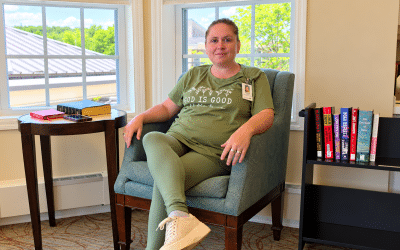
At 56, Sandra Ford sat down at a piano and rewrote her life.
Sandra Ford’s apartment at King’s Grant is warm and neat, filled with the kind of quiet tidiness that tells you someone has lived a full life: porcelain eggs, a piano tucked near the window, notebooks fat with handwritten scores, and family photos going back more than a century.
“I was married in 1956,” she says, settling into a soft chair near the kitchen. “But I was 56 years old when this hit.”
“This” is music. Composing, specifically. And it didn’t come gradually. It arrived like a weather front. One day, she came home from teaching at the First Presbyterian Church’s weekday school, walked past the piano, and couldn’t ignore it.
“I just felt to write something. I’d never written anything in my life. I mean, this was never anything I ever wanted to do.”
Though she took piano lessons for twelve years as a child, she didn’t like to practice, and by the time she sat back down in middle age, she couldn’t remember how to notate music. Theory had long since faded. So she did what anyone might do when overtaken by divine inspiration and dusty skills—she guessed. She wrote it down as best she could and paired it with a bit of text.
“It was a little anthem,” she says. “And this is kind of different.”
She showed it to her childhood friend Jane, a trained musician who lived nearby.
Sandra and Jane had grown up in the same church, both studying piano with their church organist during their school years. After college and marriage, they had both ended up in Martinsville — attending the same church once again and living in the same neighborhood. They renewed their friendship, and Jane eventually became the church organist and later the organist and choir director. Sandra worked in the same church as a kindergarten teacher and eventually as director of the preschool program.
So, when Sandra brought Jane the little Christmas anthem, Jane saw something in it. She gave it to their church choir — and they read her early effort and performed it that Christmas.
“She was being nice because it wasn’t very good,” Sandra laughs. “She said, ‘Well, I know you had fun with it. Maybe you’ll do that again.’”
Two weeks later, she did.
That second piece came stronger, clearer. Still unsure how to get it from piano bench to page, Sandra bought a book and taught herself how to write music down again. Jane liked that second piece even more — and encouraged her to keep going. The two later collaborated on a children’s musical that was performed at their church.
That’s how it started. A trickle became a compulsion.
“I had friends say, ‘Well, I haven’t seen you in a while,’ and I would say, ‘Oh, I’m writing music.’” At first, they didn’t believe her. “I had one relative say, ‘You can’t write.’ I said, ‘Well, I couldn’t. But I’m beginning to think I might.’”
Sandra went back to school. A summer at Westminster Choir College, then semesters at Roanoke College. She studied under professors who were composers themselves, relearning the language of rhythm and harmony. It was grueling.
But it worked.
By her second year, a professor approached her in the hall. “He said, ‘You haven’t signed up for next year,’ and I said, ‘Don’t feel I’m doing well.’ He said, ‘You are.’” That was enough.
She kept going.
“That second year, I think I really—it was when I really was under him. And then I went on the third year, worked under him individually. At that point, I began to feel I was confident enough to send my work to publishers.”
They said yes. Two of them.
“That second summer, I was accepted by two publishers. One was the one I had desired to be with the most, Hinshaw Publishing. The other was the Abingdon Publishing House.”
From there, things grew. Sandra wrote for children, for choirs, for sacred occasions. One of her pieces was commissioned by the Church of the Pilgrims in New York City.
“They were celebrating their 250th anniversary, and they wanted an anthem for that. Mine was chosen.” She and her husband, Jim, flew up for the performance. “That was a lot of fun.”
Her favorite composition, though, was the hardest to write.
She was approached at a choral event by a man from Florida. “He said, ‘I enjoy doing your music. My daughter was killed three weeks ago.’” She had been riding a horse on a rural road. A truck came around a bend. It didn’t stop.
“I was just shocked,” Sandra said. “We both sat and cried.”
The man asked her to write a piece in his daughter’s memory. She tried. “It just did not work at all. Nothing was working. Nothing came through.”
Then one day, it did.
In the seasons of our silence, in our darkness, in our day,
Gracious Savior, as you promised, you are never far away.
The anthem was performed. The man conducted it. His wife came, too. They stayed in touch.
“Of all the anthems I ever wrote, this was the hardest one for me to write,” Sandra says. “But it’s probably meant the most to me of any I ever wrote.”
She’s had a hard run of health. Breast cancer. Kidney cancer. Bladder cancer.
“I had to have a mastectomy and go through a really strong chemo.” Then radiation. Then more chemo—six years of it. “But it worked, and I’ve never had a recurrence.”
Now arthritis has taken much of her mobility. Playing piano is almost impossible. She last composed seriously just before COVID.
Still, she finds comfort in what she’s done.
“Probably around 50,” she says, when asked how many pieces she’s published. “Yeah, they’re still in circulation.” Sometimes she finds them online—videos of choirs performing her work, including one by a Korean choir. “That really excited me.”
Jim died eight years ago.
“I came here six months after he died,” she says of King’s Grant. “No regrets about moving. I love living here. I really do.”
Her cat, Champagne, was her companion until recently. “She just loved company. She just loved us.”
There are other things: the porcelain eggs her mother painted—miniature marvels made from real goose eggs. Her mother signed each one. A jewelry box disguised as a dollhouse. A story about a duck who bonded with the family collie and chased cars down the road. Sandra calls it “a true story.” She’d meant to write it one day.
Sandra credits many people along the way — Jane, who became her first mentor; her professors; choir members who believed in her work; and her husband, Jim, who gave her constant encouragement. “I’m so grateful for these special people in my life,” she says.
“It’s been a great life and a great journey. I’ve done things I never thought I would do, never thought I even wanted to do. Been places I never thought I’d go. And seen things I never thought I’d see.”
Then she pauses and smiles, soft as a closing line.
Listen to Sandra Ford’s compositions: